
Systemic Blind Spots: Why Persistent Against-the-Spread Underperformers in the 2011/12 Bundesliga Demanded Extreme Caution
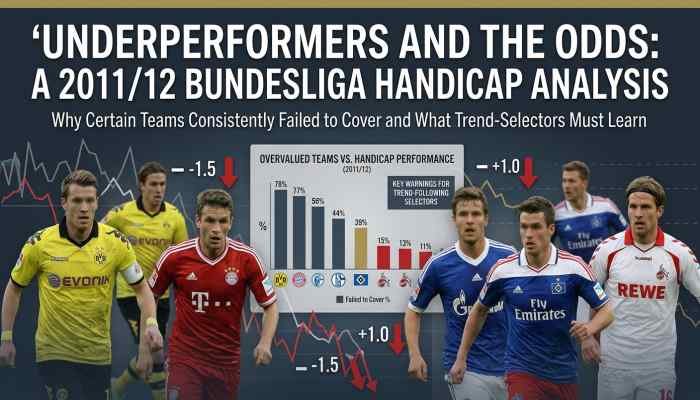
Evaluating professional football clubs strictly by their outright victories often causes analytical blind spots when transitioning to handicap and spread selection markets. The 2011/2012 Bundesliga season serves as a prime historical example where several prominent squads consistently won matches on the pitch but repeatedly failed to cover the point spreads set by oddsmakers. This divergence occurs because market prices are driven by public prestige, media hype, and past glory rather than objective, current on-field efficiency. Recognizing the underlying factors that prevent structurally flawed favorites from fulfilling inflated handicap lines is essential to avoid the costly trap of blindly backing teams based on name recognition alone.
The Mirage of the Outright Win Table in Handicap Analytics
A major error in baseline sports forecasting is equating straight-up league points with against-the-spread (ATS) efficiency. Bookmakers understand that casual fans inherently prefer backing popular, high-profile sides, which naturally inflates the handicap lines against those squads to balance out public liability. Consequently, a top-tier side during the 2011/12 German campaign could experience an impressive four-match winning streak on paper while simultaneously losing every single one of those matches from a spread perspective by failing to win by the required margin. Relying on superficial match outcomes without accounting for the built-in handicap margin inevitably erodes selection capital over time.
Deconstructing the Mechanics of Historical Premium Inflation
Market premium inflation occurs when a team’s historical reputation or star-studded roster creates an exaggerated perception of their actual match-to-match dominance. In the 2011/12 Bundesliga context, elite clubs frequently commanded massive handicap lines when playing at home against mid-table or relegation-threatened opposition. If the public pushes the spread line beyond a realistic threshold, the value instantly flips to the opposing side, regardless of who actually secures the three points. Understanding this structural bias allows disciplined data analysts to remain detached from emotional narratives and view the market strictly as a numbers game.
Structural Triggers That Sustained Negative Handicap Realities
Identifying why certain teams continuously failed to cover their assigned spreads requires looking deeply into their tactical limitations and structural inefficiencies. During the 2011/12 German top-flight season, specific squads suffered from systemic issues that prevented them from turning spatial dominance into multi-goal victories. By compiling these persistent operational vulnerabilities into a clear categorization, analysts can easily observe how a team’s tactical DNA directly works against its market expectations.
| Squad Vulnerability Profile | On-Field Tactical Catalyst | Statistical Byproduct | Direct Handicap Impact |
| Inefficient Possession Cycles | Lack of vertical penetration | Low xG despite high passing volume | Frequent narrow 1-0 or 2-1 victories |
| High Defensive Line Fragility | Vulnerability to vertical long balls | High big-chance conversion conceded | Conceding late goals that spoil the spread |
| Symmetrical Attacking Rotations | Predictable wide isolation plays | High volume of low-probability crosses | Inability to break down low-block defenses |
The relationship matrix detailed above demonstrates that systemic spread underperformance is rarely an accident; it is the direct consequence of unadjusted structural choices. When an elite side relies on slow, horizontal passing sequences, they intentionally lower the overall variance and match tempo, which plays directly into the hands of a deep-lying underdog protecting a head-start cushion. Interpreting these historical data distributions proves that an analyst must evaluate whether a favorite possesses the explosive, counter-pressing mechanisms needed to sustain a multi-goal margin before allocating capital to their side.
The Psychological Danger of Doubling Down on Popular Underachievers
Trend-following selectors frequently fall victim to the gambler’s fallacy, assuming that a top-tier team that has failed to cover the spread for five consecutive weeks is mathematically “due” for a blowout victory. This psychological bias ignores the reality that oddsmakers adjust their lines based on public handles, not individual team redemption arcs.
Structural Performance Baselines vs. Public Expectation
If a prestigious 2011/12 Bundesliga club continued to struggle creatively due to injuries or managerial rigidity, their underlying output remained severely compromised. Assuming that a squad will magically correct its underlying deficiencies simply because of its club crest represents a severe breakdown in analytical discipline that often leads to compounding losses.
The Hidden Penalty of Late-Game De-escalation
Another primary cause of persistent spread failure among superior teams is tactical de-escalation once a comfortable lead is secured. When a top-tier manager pulls off their star attackers in the 70th minute to preserve energy for upcoming European fixtures, the team’s offensive output drops significantly. This structural shift creates a perfect window for an aggressive underdog to score a late, cosmetic goal that has zero impact on the actual match outcome but completely destroys the favorite’s handicap coverage.
Navigating Inefficient Trends via Alternative Analytical Frameworks
When standard sports markets become overly distorted by emotional public narratives and inflated historical biases, maintaining long-term financial discipline requires exploring alternative statistical landscapes. If a weekend’s Bundesliga slate features nothing but overvalued favorites with unappealing handicap lines, forcing a position violates core risk-management principles. Observation of modern probability distribution indicates that diversifying capital into a premier casino online website provides an objective ecosystem completely insulated from public fan biases and media distortions. Shifting attention to fixed-coefficient digital frameworks allows an analytical selector to exercise pure probability modeling and statistical patience, ensuring that capital deployment remains driven by mathematical value rather than forced, sub-optimal sports trends.
Identifying the Inflection Points Where Negative Trends Reverse
While avoiding persistent underperformers is a sound baseline strategy, an elite analyst must also recognize the precise conditional markers that signal a negative trend has run its course. A team’s poor against-the-spread run will eventually bottom out once the oddsmakers lower their valuation baseline sufficiently, or when specific personnel changes alter the team’s tactical ceiling.
- Sustained Market De-escalation: The moment oddsmakers drop a traditional favorite’s baseline handicap from a minus-1.5 margin down to a more achievable minus-0.5 hook.
- Return of Primary Transition Outlets: The reintroduction of a highly efficient, press-resistant deep playmaker who can unlock stalled possession sequences.
- Drastic Managerial Adaptation: A clear tactical shift from a predictable possession style to a more direct, high-tempo attacking architecture that actively maximizes goal variance.
Securing Selection Stability in Modern Operational Environments
Capitalizing on structural market imbalances requires executing your final positions through modern digital infrastructures that guarantee line stability and competitive price retention. If an analytical model successfully identifies an inflated Bundesliga favorite that is mathematically primed to drop another spread, securing the optimal underdog line before sharp syndicates force an adjustment is vital. Situational conditions dictate that utilizing a highly responsive sports betting service like ยูฟ่า168 สล็อตออนไลน์ ensures that data-driven selectors can lock in their positions at the precise peak of public inflation. Relying on top-tier analytical tools and execution environments allows professional selectors to transform public bias into a sustainable, long-term mathematical advantage.
Summary
Exercising extreme caution with persistent against-the-spread underperformers from the 2011/12 Bundesliga season highlights the necessity of separating on-field victories from market value. Teams heavily backed by public sentiment are regularly saddled with inflated handicaps that their tactical frameworks, slow tempos, or late-game de-escalations cannot realistically fulfill. By identifying core metrics such as inefficient possession structures, high defensive lines vulnerable to counter-attacks, and public-driven premium inflation, analysts can avoid the trap of chasing prestigious but unprofitable favorites. Ultimately, long-term success relies on maintaining strict statistical detachment, recognizing that the highest value is frequently found by fading the public consensus.